Grown-Up Goals. Kid-Sized Joy. Learning in disguise.

Fizzy Foamy Volcano
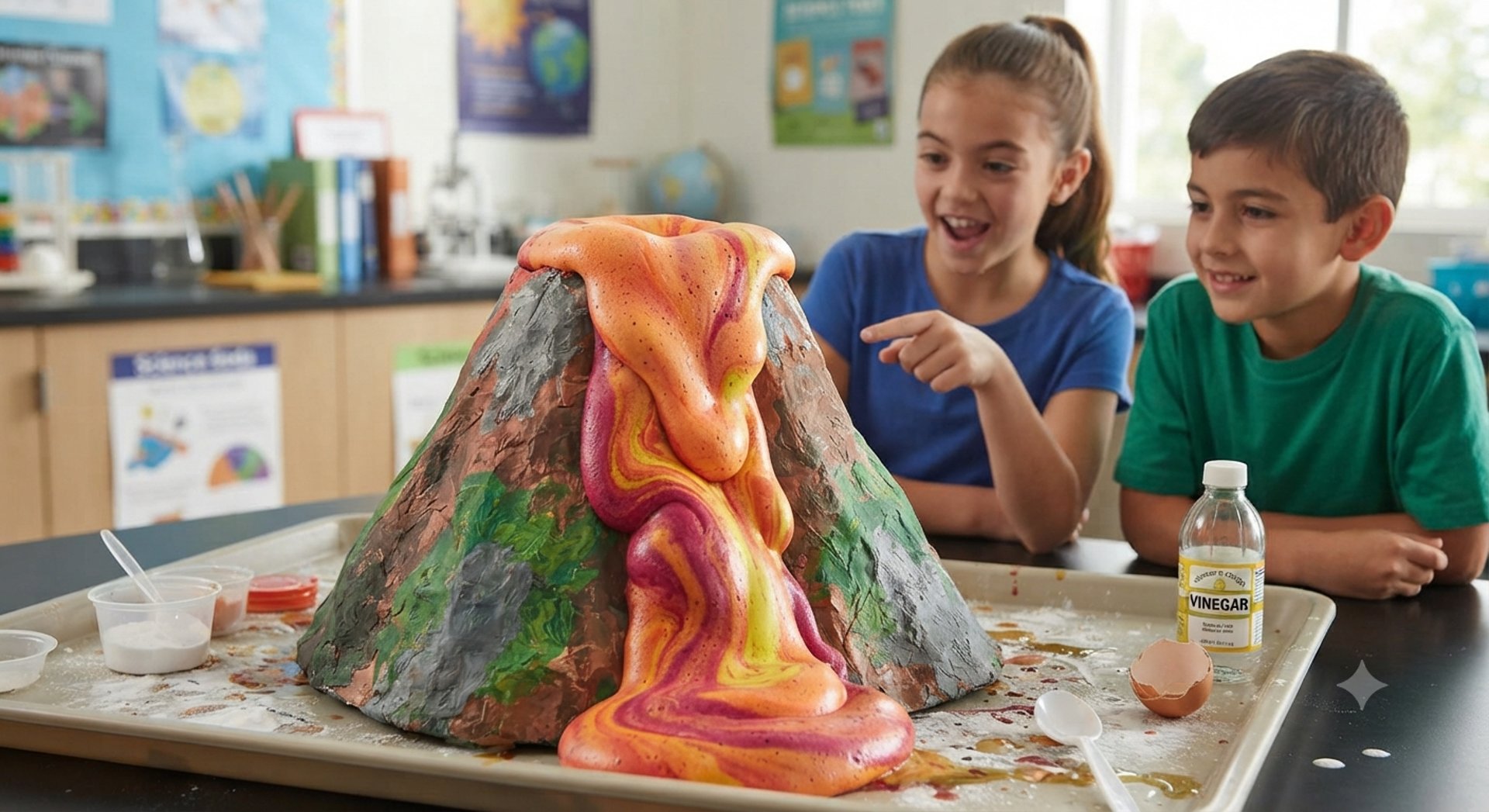
Combining baking soda, egg white, and vinegar creates a fantastic, lesser-known twist on the classic baking soda volcano. While dish soap is typically used to trap carbon dioxide gas and make foam, egg white works even better to create a thick, stable, and long-lasting eruption!
Here is how to set up this exciting "Fizzy Egg Foam" STEM project.
Materials Needed
Egg white (separated from the yolk)
Baking soda (about 1 to 2 tablespoons)
White vinegar (about 1/4 cup)
Liquid food coloring (optional, for vibrant, colorful foam)
A container (a small cup, beaker, or a fun shaped container like a hollowed-out mini pumpkin or plastic cup)
A wooden stick or spoon for stirring
A tray or plate (to catch the overflowing foam)
Step-by-Step Instructions
Prepare the Base: Separate the white from one egg and pour the egg white into your container.
Add the Base (Baking Soda): Add 1 to 2 tablespoons of baking soda directly into the egg white. Stir it thoroughly with a wooden stick.
Color the Acid: In a separate small cup, mix your white vinegar with a few drops of your favorite food coloring.
Trigger the Reaction: Pour the colored vinegar into the container with the egg white and baking soda mixture.
Watch it Burst: Stir the mixture slightly with the stick and watch as a thick, colorful, slow-moving foam dramatically erupts out of the container!
The Science Behind the STEM Project
The Acid-Base Reaction: Vinegar contains acetic acid, and baking soda is a base (sodium bicarbonate). When they mix, they neutralize each other and undergo a chemical reaction that rapidly produces carbon dioxide ($CO_2$) gas.
The Role of the Egg White: Normally, a baking soda and vinegar reaction creates a fast, watery fizz that disappears instantly. However, egg whites are packed with proteins. When you agitate or stir the mixture, these proteins unfold, trap the escaping carbon dioxide gas, and build a sturdy, elastic network around the bubbles. This turns a quick fizz into a rich, voluminous foam (acting much like meringue).
Extension Questions for Exploration
Comparison: Try doing the experiment side-by-side: use just baking soda and vinegar in one cup, dish soap and the reaction in a second cup, and the egg white in a third cup. Which one produces the longest-lasting foam?
States of Matter: Can you identify the solid, liquid, and gas present during different stages of the experiment?
Questions? Comments? Concerns?
info@joyfulletters.com
Affiliate Disclosure: Some of the links on this page are affiliate links. As an Amazon Influencer, a Walmart Partner, and an affiliate for select educational brands, I earn a small commission from qualifying purchases. This never raises the price for you. I only recommend items that add true value to a play-based learning environment. Thank you so much for supporting our page!
© Joyful Letters 2025-2026 ALL RIGHTS RESERVED. Permission is given to reproduce for individual classroom use. Our content material is not to be resold.