Grown-Up Goals. Kid-Sized Joy. Learning in disguise.
Fine Motor Activities

Motor skill practice through play:
Developing fine motor skills is a critical component of early childhood development, as these small muscle movements—primarily in the hands, wrists, and fingers—are essential for daily self-care tasks, academic readiness, and building overall dexterity.
Here are the benefits of these engaging activities for developing fine motor control:
Bead threading on a string: Enhances hand-eye coordination and the "pincer grasp," which is foundational for later writing skills.
Playdough pinch and roll: Strengthens hand muscles and increases grip strength, preparing fingers for the resistance needed to hold a pencil correctly.
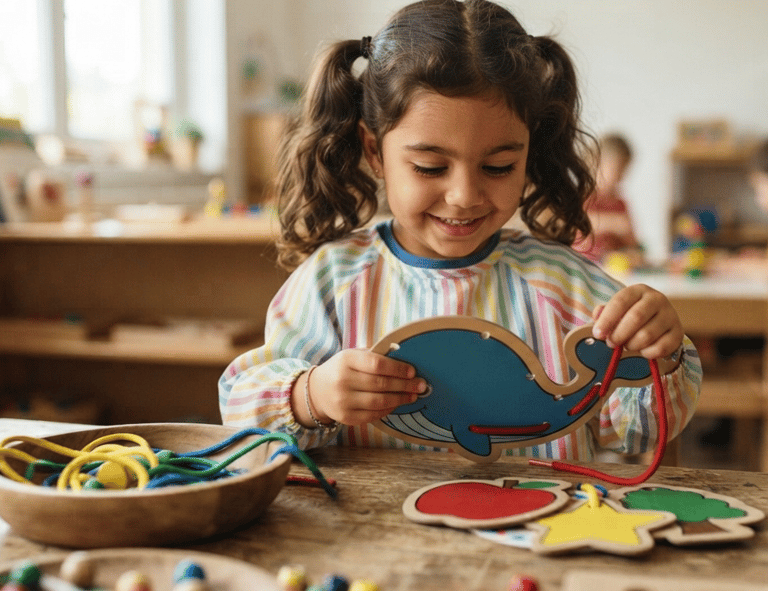
Lacing Cards: Improves bilateral coordination as children learn to hold the card steady with one hand while threading the lace with the other.
Scissor practice cutting on straight or curved lines: Builds hand-eye coordination and spatial awareness, specifically targeting finger isolation and the muscle endurance needed for cutting tasks.
Pom Poms in a plastic jar with a small hole in the lid: Focuses on precision and target accuracy, helping children refine their control over small objects.
Clothespin clip on: Excellent for building finger strength and the specific "pincer squeeze" necessary to manipulate small objects and classroom tools.
Dropping play money coins into a piggy bank: Promotes precise orientation and spatial planning as children manipulate a flat object to fit through a narrow, specific slot.
Using tongs or kid-safe tweezers to move items: These tools act as an extension of the fingers, requiring refined pressure control and stability to grasp, hold, and release items.
Peel and stick stickers: Encourages the use of the thumb and index finger to navigate edges and textures, developing the dexterity needed for intricate work.
Paper tearing and gluing: Tearing paper strengthens the intrinsic muscles of the hand, while gluing requires steady, controlled application—both essential for craft and art projects.
Dressing skills: buttons and zipper practice: Integrates fine motor control with real-life application, fostering independence through complex coordination and manipulation tasks.
Nuts and bolts: Requires rotational wrist movement and finger strength, helping children develop the ability to manipulate and connect mechanical parts.
Shape tracing, letter tracing: Bridges the gap between muscle control and visual-motor integration, teaching the hand to follow specific paths and patterns required for future handwriting.
Peg in a hole activity: Develops precision, hand-eye coordination, and finger isolation as the child aligns the peg with the target opening and applies the necessary pressure to insert it.
Plastic loops linking together: Enhances bilateral coordination—using both hands to perform different, complementary tasks—and
These activities are wonderful ways to encourage the development of these skills in a playful, natural way.
Questions? Comments? Concerns?
info@joyfulletters.com
Affiliate Disclosure: Some of the links on this page are affiliate links. As an Amazon Influencer, a Walmart Partner, and an affiliate for select educational brands, I earn a small commission from qualifying purchases. This never raises the price for you. I only recommend items that add true value to a play-based learning environment. Thank you so much for supporting our page!
© Joyful Letters 2025-2026 ALL RIGHTS RESERVED. Permission is given to reproduce for individual classroom use. Our content material is not to be resold.