Grown-Up Goals. Kid-Sized Joy. Learning in disguise.
Speech Help for Preschoolers
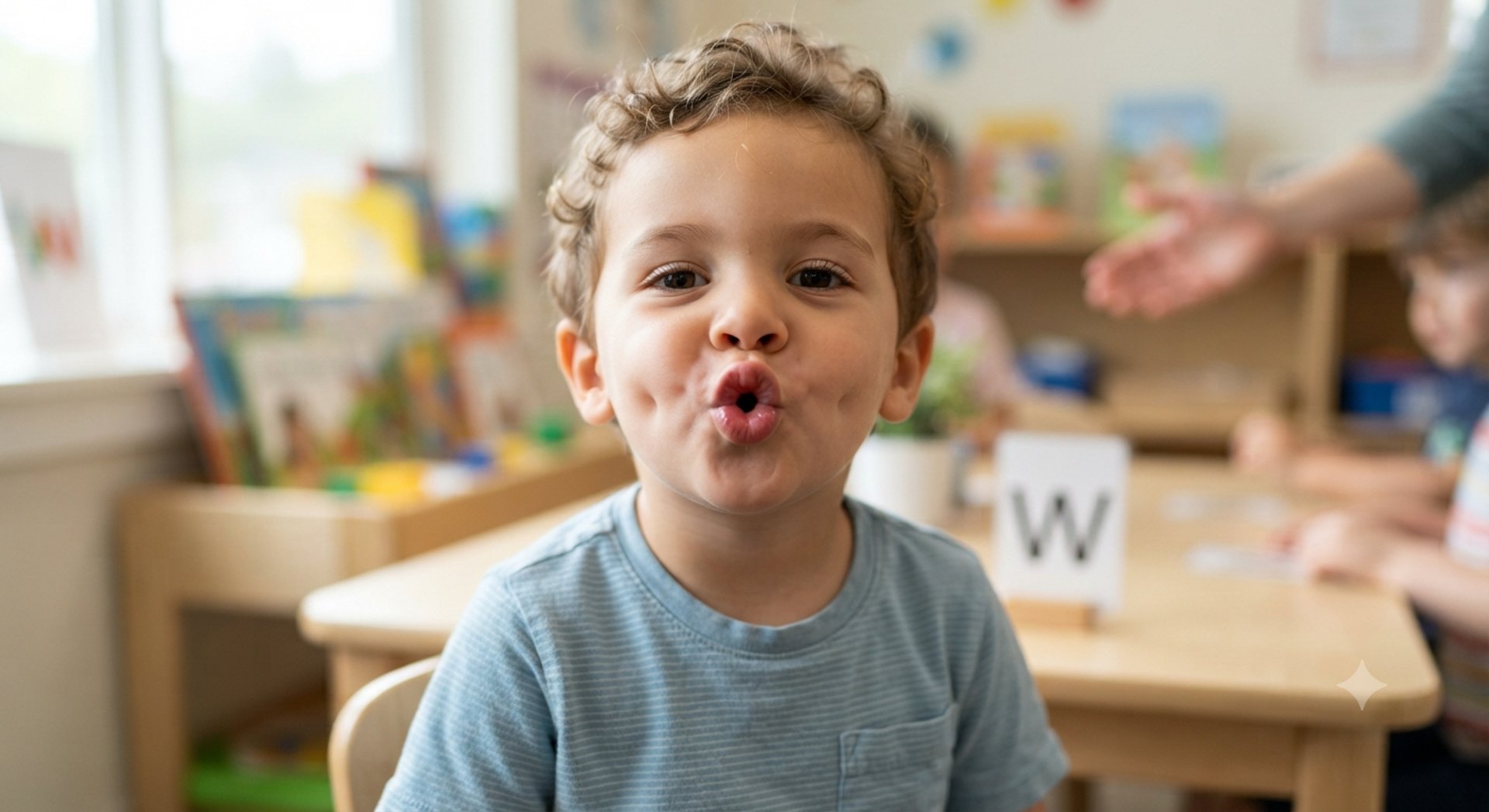
Do you have children in your classroom who are very difficult to understand? While we wait for formal speech evaluations, both we and the children can feel deeply frustrated by communication barriers. Here are some practical ideas to help build foundational speech skills right away:
Master List of Consonant Teaching Ideas for Preschoolers with Speech Difficulties
You can make a positive difference in their speech with these playful activities.
B / P
Bubble Blowing: Have children blow bubbles while feeling their lips pop open together to create the "B" and "P" sounds.
Feather Race: Hold a lightweight feather or cotton ball in front of the mouth and practice a sharp P breath ("Pop!") to make it fly.
Mirror Mimicry: Sit in front of a mirror together and exaggerate closing lips tightly before bursting them open for B words like bubble, ball, and bear.
M
Humming Hands: Place hands lightly on the throat or cheeks to feel the vibration while making a continuous "Mmmmm" sound, pretending to be a happy engine or a tasting-good snack ("Mmmm, yummy!").
Yummy Snacks: Use snack time to naturally elicit M words by asking, "More milk?" or "Mmm, mango!" while rubbing tummies.
T / D
Clock Ticking: Pretend to be a grandfather clock, tapping the tongue tip right behind the front teeth to make crisp T sounds (tick-tock, tick-tock).
Drum Beats: Tap a toy drum or table while saying D words in rhythm (ducks, dogs, doors), focusing on the sharp tongue-tip tap.
F / V
Bite-the-Lip Practice: Teach children to gently rest their top teeth on their bottom lip, like a friendly bunny rabbit, before blowing air out to make the F sound (fun, fish, fan).
Vacuum Voice: Pretend to vacuum the floor and make a buzzing V sound (Vrrrrm, like a motor or vacuum cleaner) while feeling the vibration on the lower lip.
K / G
Coughing Game: Practice a gentle, pretend throat-clear or soft cough to help locate where the back of the tongue goes for K and G sounds (kitten, key, go, gate).
Gargling Pretend: Play a game of pretending to gargle water (without actual liquid) to activate the back of the throat and encourage crisp G articulation.
S / Z
Sleek Snake: Make a long, hissing snake sound (Sssss) with teeth gently together and lips stretched into a smile, keeping the tongue safely behind the teeth.
Buzzing Bee: Transform the snake into a buzzing bee (Zzzz) by adding voice vibration while keeping the same mouth shape.
L
Lollipop Licks: Pretend to lick an imaginary lollipop, sweeping the tongue tip up behind the front teeth to the spot where L lives (lemon, leaf, lion).
Sing-Song Humming: Practice singing scales or prolonged vowels while lifting the tongue tip to encourage smooth, flowing airflow without bunching the tongue.
R
Motorboat Lips: Pretend to drive a motorboat (Brrrrr) to loosen up the lips and jaw before trying vocalized R words (red, rabbit, ring).
Growing Tree: Stretch arms up high like a tall tree swaying in the wind while making a deep, retroflex R sound, focusing on pulling the tongue back without touching the teeth. What is the retroflex R? Think of the difference between saying "Cat" (flat tongue) and "Car" (curled tongue). When you say Car, your tongue tip lifts off the floor of your mouth and pulls back toward the ceiling. That physical curling action is what creates a retroflex "R"!
SH / CH / J
Shushing Baby: Place a finger over the lips and practice a quiet, long Shhh sound to calm a toy doll or animal.
Train Chug: Chug along like a steam locomotive (Choo-choo!) to practice the sharp stop-and-release of the CH sound.
Jumping Jacks: Do jumping jacks while making a bouncy J sound (jump, jar, jelly).
Y
Yawn and Stretch: Start with a big, exaggerated morning yawn to open the throat, then glide straight into a bright Y sound (yellow, yo-yo, yarn).
Puppy Whine: Pretend to be a playful puppy asking to play, making a sliding, high-pitched Y sound (yip-yip!).
H
Fogging the Mirror: Breathe heavily onto a hand or a small mirror to create a warm fog, practicing the effortless, breathy H sound (hat, house, hand).
Happy Puppy Pant: Pant like a happy dog resting in the sun (H-h-h-h), focusing on smooth, relaxed airflow straight from the chest without straining the throat.
W
Owl Hoots & Wind Blows: Round the lips tightly into a tiny circle just like an owl or a wind tunnel, practicing the rounded W glide (water, wagon, wig).
Puppy Whistle: Purse the lips as if blowing out a birthday candle or whistling for a pet to anchor the round, forward lip posture required for crisp W articulation.
Th
Friendly Tongue Peek: Gently place the tip of the tongue between the top and bottom teeth—like a shy turtle peeking out of its shell—before blowing gentle air for the unvoiced Th (thumb, three, tooth).
Buzzing Bee Tongue: Keep the tongue in that same gentle dental position and turn on the voice box to make the voiced Th sound (this, that, feather).
Certain vowels and vowel combinations frequently present challenges for young children, even though vowels are generally voiced more easily than consonants. Because vowels require precise tongue positioning, jaw height, and lip rounding inside the oral cavity, they can sometimes be tricky or distorted.
Here is a look at the vowels and vowel patterns that most commonly cause speech difficulties, along with playful ways to practice them:
R-Controlled Vowels ("Bossy R": ar, or, er, ir, ur)
The Issue: These are notoriously difficult because the vowel sound and the R sound merge into a single, complex glide that requires exact tongue retraction and tension.
Practice Idea:
Car Horns: Pretend to honk a car horn while stretching the AR sound ("Beep beep, car!").
Pirate Voices: Say "Arrrr!" while pretending to steer a pirate ship, focusing on pulling the back of the tongue up and back without bunching it.
Diphthongs (Gliding Vowels: oy/oi as in boy, ow/ou as in cow, i as in ice)
The Issue: Diphthongs require the tongue and lips to smoothly glide from one vowel position to another within a single syllable. Children often get "stuck" on the first vowel or drop the second half.
Practice Idea:
Cow Sounds: Make a sliding OW sound like a cow stretching out a "Moo-oooo-ow!" to practice the mouth opening wide and rounding down.
Rollercoaster Glides: Use a finger to trace a hill in the air, starting low and sliding high for I ("Hi!", "Light!"), matching the vocal slide to the physical movement.
High Front Vowels (ee as in tree, i as in sit)
The Issue: Producing a crisp EE sound requires stretching the lips wide into a smile and keeping the tongue high and forward. Children with tongue-thrust habits or jaw closure issues often substitute these with wider, back vowels (like "ah" or "aw").
Practice Idea:
Big Smile Cheese: Hold a wide, happy smile like a camera flash while singing a long, sustained EE sound ("Sleek green tree!").
Squeaky Mouse: Pretend to be a tiny, squeaky mouse making a high-pitched EE sound to encourage forward tongue placement.
Back Round Vowels (oo as in moon, oh as in boat)
The Issue: These require puckering or rounding the lips tightly while keeping the back of the tongue raised. Children who struggle with lip posture often spread their lips instead, turning "shoe" into "shee."
Practice Idea:
Fish Face / Train Whistle: Make a tight "fish face" or pretend to pull the cord on a steam train while hooting out a deep, rounded OO sound ("Whooo-whooo!").
Ghostly Echo: Practice a spooky, rounded ghost sound ("Ooooooh!") while looking in a mirror to check that the lips stay in a tight O-shape.
Here is a collection of engaging, breath-and-airflow games using everyday objects, along with the specific speech sounds and oral-motor skills they target:
Tissue Bowling / Tissue Push
The Game: Stand a lightweight facial tissue up like a tiny tent or place a crumpled tissue ball on a smooth table. Have the child take a deep breath and blow it across the table to knock over plastic bowling pins or score a "goal."
Sounds & Skills Targeted:
F, V, S, Z: Teaches children how to direct a steady, continuous stream of air over a longer duration rather than letting all their air burst out at once.
Breath Control: Strengthens overall respiratory support and teaches diaphragmatic breathing, which helps children sustain airflow for longer sentences.
Straw Soccer / Straw Target Practice
The Game: Set up a mini goal using two blocks. Place a lightweight cotton ball, a pom-pom, or a crumpled paper ball on the table. Give the child a straw and have them use breath suction (briefly) or continuous blowing through the straw to guide the ball into the goal.
Sounds & Skills Targeted:
P, B, T, D, K, G: Helps children learn how to build up intra-oral air pressure and release it in sharp, controlled bursts.
Lip Rounding & Closure: Encourages tight, puckered lip closure around the straw, which directly supports the muscle posture needed for W, OO, and rounded vowels.
Cotton Ball Races
The Game: Draw a race track on a piece of paper or tape a line on the floor. Place cotton balls at the starting line, get down at eye level, and have a contest to see who can blow their cotton ball across the finish line first using only puffs of air.
Sounds & Skills Targeted:
P and B: Practicing short, sharp puffs ("Puff! Puff!") mimics the exact mouth and breath action required to pop open the lips for crisp bilabial stops.
Jaw Stability: Encourages the jaw to remain relatively stable while the lips and tongue do the work of directing the air.
Feather Floating (Up in the Air)
The Game: Hold a lightweight feather up in the air and have the child try to keep it afloat by blowing upward underneath it, seeing how many seconds they can keep it from touching the ground.
Sounds & Skills Targeted:
H and Wh- / W: Promotes open, relaxed throat airflow for H and upward, rounded breath streams for glides.
Oral Awareness: Teaches children to feel the temperature and direction of the air coming out of their mouths, building spatial awareness of their oral cavity.
Pom-Pom Blow Through a Maze
The Game: Draw a winding maze on a piece of cardboard or paper. Place a small felt pom-pom at the start and have the child blow it through the twists and turns using a straw or just controlled mouth puffs.
Sounds & Skills Targeted:
Directional Airflow Control: Crucial for S and SH, where the air must be channeled precisely over the center of the tongue rather than spilling out the sides (which causes a lisp or lateral distortion).
Ping-Pong Blow (Table Tennis Target)
The Game: Set up a small goal at one end of a table or use a shoebox lid. Have the child use a straw or direct mouth puffs to blow a lightweight ping-pong ball across the surface into the goal. You can add obstacles like building blocks to create a "pinball" effect.
Sounds & Skills Targeted:
P, B, T, D (Plosives): Encourages strong, targeted bursts of air to move a heavier object, building the oral pressure needed for crisp stops.
Abdominal and Breath Support: Requires a deeper diaphragmatic breath to sustain movement across a longer distance.
Paper Boat Regatta
The Game: Fold simple paper boats (or use plastic container lids) and float them in a shallow bin of water or a sink. Have the child navigate the boats across the "ocean" using gentle, sustained puffs of air or short, choppy puffs to make the boat "speed up."
Sounds & Skills Targeted:
F, V, S, Z, SH (Fricatives): The tactile feedback of seeing ripples in the water helps children visually connect their airflow to sound production. Sustained blowing helps correct interdental lisps by keeping air moving forward.
Pom-Pom Drop / Cup Target
The Game: Line up a row of plastic cups or muffin tins. Place a small pom-pom a few inches away and challenge the child to use a sharp, single puff of air ("Pop!") to land the pom-pom inside a specific cup.
Sounds & Skills Targeted:
K, G, and P, B: Teaches children how to meter out exact amounts of air rather than running out of breath, supporting precise articulation timing.
Horn and Whistle Instruments
The Game: Use toy slide whistles, party blowers, harmonicas, or slide flutes. Have the child play specific rhythms or try to make the instrument sustain a note for a set number of seconds.
Sounds & Skills Targeted:
Vocal Cord Coordination & Pitch Glides: Excellent for diphthongs and R-controlled vowels because it teaches the child how to smoothly transition air and oral shaping to change pitch.
Lip Strength: Party blowers and whistles require strong orbicularis oris muscle closure, which helps eliminate weak lip postures for W, OO, and B/P.
Bubble Snake (Sock Blower)
The Game: Take a clean plastic water bottle, cut off the bottom, and stretch an old sock or washcloth tightly over the open end. Secure it with a rubber band. Dip the sock end into a shallow dish of bubble solution, and have the child blow gently through the bottle opening to create a long, continuous "snake" of bubbles.
Sounds & Skills Targeted:
S, Z, and SH (Fricatives): The continuous breath stream required to grow a long bubble snake teaches children how to sustain airflow without letting it break or fade, which is essential for clear, non-distorted fricatives.
Breath Regulation: Helps children balance the force of their breath so they don't blow too hard (which pops the bubbles) or too softly.
Cotton Ball Hockey
The Game: Set up two small goal lines on a smooth table using blocks or tape. Give the child (and yourself) a small plastic spoon or a craft stick to act as a hockey stick, but with a twist: instead of hitting a ball with the stick, use the stick to block or guide, while using mouth puffs to move a cotton ball across the table into the net.
Sounds & Skills Targeted:
P, B, T, D (Stops): Encourages rapid alternation between inhaling and executing sharp, targeted bursts of air ("Puh! Puh!") to score a goal.
Oral-Motor Agility: Combines hand-eye coordination with precise mouth positioning, helping coordinate breath with articulators.
Pom-Pom Blow-Up (Cup Pyramid)
The Game: Stack lightweight plastic cups into a small pyramid. Place a light pom-pom or a crumpled paper ball a few inches away, and have the child act as a "windstorm" to knock the pyramid down using a single, powerful breath or a series of rapid puffs through a straw.
Sounds & Skills Targeted:
K, G, and P, B (Plosives): Building up the intra-oral air pressure needed to knock over stacked cups teaches children how to trap air briefly in the mouth before releasing it with an explosive pop.
Abdominal Support: Strengthens core respiratory muscles to ensure children aren't just straining their throats when trying to produce louder or crisper consonant sounds.
Questions? Comments? Concerns?
info@joyfulletters.com
Affiliate Disclosure: Some of the links on this page are affiliate links. As an Amazon Influencer, a Walmart Partner, and an affiliate for select educational brands, I earn a small commission from qualifying purchases. This never raises the price for you. I only recommend items that add true value to a play-based learning environment. Thank you so much for supporting our page!
© Joyful Letters 2025-2026 ALL RIGHTS RESERVED. Permission is given to reproduce for individual classroom use. Our content material is not to be resold.