Grown-Up Goals. Kid-Sized Joy. Learning in disguise.
Construction Site

This center will encourage imaginative play, develop fine motor skills, and develops teamwork and problem-solving skills in young children.
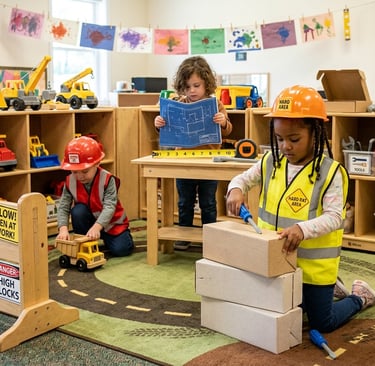
Atmosphere: Create a construction-themed atmosphere with posters of construction vehicles, hard hats, and construction sounds.
Materials
Toy Tools: Hammers, screwdrivers, wrenches, pliers, measuring tapes (child-sized and safe)
Blocks: Large and small blocks of various shapes and sizes for building structures.
Hard Hats: Child-sized hard hats for the children to wear.
Toy Trucks: Dump trucks, construction trucks, bulldozers, backhoes.
Optional Items:
Cardboard boxes to use as buildings
Items: Toy tools, blocks, hard hats, toy trucks.
Backdrop
Activities
Building Structures: Encourage children to build roads, bridges, and buildings using the blocks and other materials.
Vehicle Play: Have children use the toy trucks to transport materials, dig, and demolish structures.
Role-Playing: Encourage children to role-play as construction workers, architects, or engineers.
Fine Motor Skills: Have children practice using the toy tools to hammer, screw, and build.
Problem-Solving: Encourage children to work together to solve problems, such as how to build a stable bridge or how to transport large objects.
Storytelling: Have children create stories about the construction site, using the toys and materials.


Construction Literacy Activities
The "Work Order" Station
Place clipboards, pencils, and "Work Order" printables in your block or cardboard center.
The Activity: Before they start building, ask the children to "draw their plan."
The Skill: Moving from abstract ideas to concrete representation.
Another option: Create some building simple building plans for using blocks. Let the children duplicate the picture or follow the directions to use certain pieces to create a building.
Sensory Site Signs
Create small construction signs (Stop, Detour, Hard Hat Area) to place around the classroom
The Activity: Point to the signs during transitions. "Oh, I see a 'Slow' sign near the cubbies; we should walk like turtles there."
The Skill: Environmental print recognition.

Project-Based Learning:
Introduce a building challenge: "Can we build a bridge that can hold these toy cars?" or "Let's build a tall tower."
Have children work in teams to plan, design, and construct their projects.
Design collaborative building projects that require children to work together to achieve a common goal.
Encourage them to communicate their ideas and negotiate solutions.
Encourage them to document their progress with drawings or simple observations.
Hold brief "meetings" where children can share their plans, discuss challenges, and brainstorm solutions.
Teach them how to listen to each other and respect different perspectives.
Tool Exploration and Skill Development:
Provide different types of "tools": play wrenches, screwdrivers, and even paintbrushes for "painting" their structures.
Teach children how to use the tools safely and effectively.
Introduce simple measurement concepts with play rulers or measuring tapes.
Dramatic Play Integration:
Add a "construction office" area with a clipboard, paper, and play phone.
Encourage children to role-play as architects, engineers, and construction managers.
Set up a "delivery station" for transporting materials with the toy trucks.
Integrating Literacy and Math:
Create construction-themed vocabulary cards with pictures and words.
Have children count blocks, measure lengths, and sort materials by size or shape.
Create a "blueprint" station were the children can draw out their building plans
Construction Site Field Trip:
If possible, take a field trip to a real construction site to observe the building process firsthand.
Construction Apps and Videos:
Use apps or videos to show children how buildings are constructed or how different construction vehicles work.
Use tablets to take pictures of their construction projects.


Top Construction Books for Preschoolers
The "Big Machine" Classics
"Goodnight, Goodnight, Construction Site" by Sherri Duskey Rinker: A rhythmic, soothing bedtime story that introduces all the major trucks (Crane, Mixer, Dump Truck) as they finish their work and tuck in for the night.
Construction Site Preschool Activity Book: Fun Learning with Trucks, Tools, and Mighty Machines
by Liv Wan Kids can explore the busy, noisy world of excavators and jackhammers with Construction Site Preschool Activity Book. T
"Little Excavator" by Anna Dewdney: Perfect for younger preschoolers who might feel small; it shows how the littlest machine can sometimes do the job the big ones can't.
Process & Concept Books
"Building a House" by Byron Barton: A very simple, step-by-step look at the actual process of construction—from digging the hole to painting the walls. Excellent for explaining the "why" behind the tools.
"Dreaming Up: A Celebration of Building" by Christy Hale: This unique book pairs photos of world-famous architecture with illustrations of children building similar structures out of blocks, cups, and cardboard.
"Roadwork" by Sally Sutton: Full of "noisy" words (clank, bang, thud) that make it a high-energy read-aloud for circle time.
Problem-Solving & Grit
"Rosie Revere, Engineer" by Andrea Beaty: While slightly more text-heavy, it is wonderful for the older 5-year-old group. It teaches that "failed" inventions are just steps toward success.
"Boxitects" by Kim Smith: Specifically focuses on building with cardboard boxes, making it the perfect tie-in for your construction center.
Questions? Comments? Concerns?
info@joyfulletters.com
Affiliate Disclosure: Some of the links on this page are affiliate links. As an Amazon Influencer, a Walmart Partner, and an affiliate for select educational brands, I earn a small commission from qualifying purchases. This never raises the price for you. I only recommend items that add true value to a play-based learning environment. Thank you so much for supporting our page!
© Joyful Letters 2025-2026 ALL RIGHTS RESERVED. Permission is given to reproduce for individual classroom use. Our content material is not to be resold.