Grown-Up Goals. Kid-Sized Joy. Learning in disguise.
4th of July Celebration

Monday -Introduce the American Flag (colors and stars)
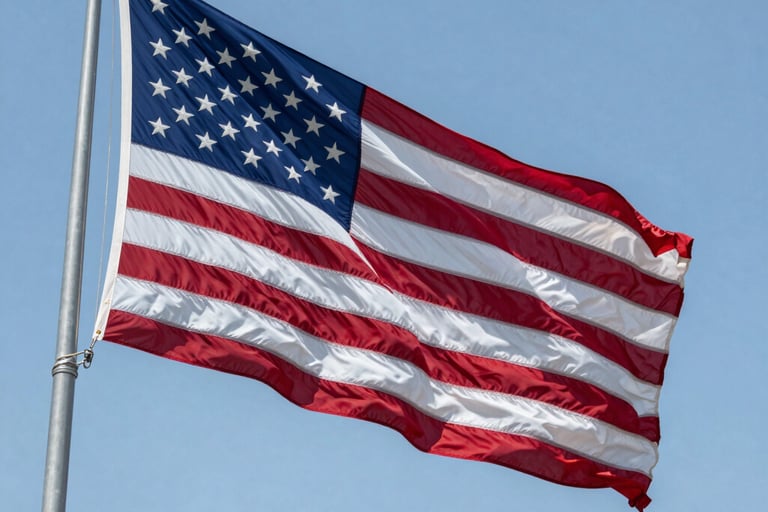
Introducing the American flag to preschoolers works best when you treat it like a vibrant piece of discovery rather than a history lecture. At this stage, children don't need to memorize historical dates or complex government ideas; they just need to understand that the flag is a special symbol—a "picture" that stands for our big neighborhood.
Here is an engaging circle time approach, utilizing a tactile mystery box, to introduce the flag through patterns, colors, and interactive counting.
📦 The "Mystery Box" Circle Time Setup
Props needed:
A real fabric American flag tucked inside a decorative gift bag or box.
Small individual hand flags for the children to hold later.
Teacher: (Shaking a beautifully wrapped box) "Class, I have a big secret inside my mystery box today. Inside this box is a very special piece of cloth. It has a beautiful pattern on it, it flies high in the wind, and it tells everyone exactly where we live. Do you want to count to three with me and help me pull it out?"
Children: "Yes!"
Teacher: "Let's use our big counting voices. One... Two... Three!" (Slowly pull the flag out, holding it up high so it unfolds completely). "Look at that! What did we find?"
Children: "The flag! The American flag!"
🕵️♂️ Exploring the Features (Math & Pattern Recognition)
Instead of just telling them about the flag, let them look closely at its features to practice basic math and observation skills:
The Colors: "Look at these bright colors. We have bold red, bright white, and a deep blue square right here in the corner. If you see the color blue, give your knees a tap!"
The Stripes (Pattern Making): "Look at these long lines. They go across like a train track. Let’s trace them with our fingers in the air. Red, white, red, white... Look at that, it's an ABAB pattern! Let's clap the pattern together: Clap for red, pat your lap for white. Red... white... red... white!"
The Stars (Counting & Shapes): "And look at this blue square. What is hiding inside it? Tiny, glittering stars! There are a lot of stars here—each one represents a different state in our country. Let's practice making a star with our hands by stretching our fingers out wide like a starburst. (Close your fist and pop your fingers out into an imaginary five point star)"
🗽 What Does It Mean? (The Kid-Friendly Definition)
Teacher: "Our flag is a symbol. Remember our special word? A symbol is a picture that stands for something else. This flag is a giant picture that says, "You live in a beautiful place called America where we take care of each other and try to be good neighbors.' Whenever you see this flag flying outside the school, at the park, or in a parade, it is a reminder that we are all part of the same big team."
Hands-On Centers
Once circle time is over, you can bridge this introduction into your play centers so they can recreate the shapes and patterns they just saw:
Playdough Station: Provide red, white, and blue playdough along with star-shaped cookie cutters and plastic rolling pins. Children can practice rolling out long "snakes" to make stripes or stamping stars.
Tissue Paper Flag Collage: Draw a basic flag outline on cardstock (a blue rectangle in the corner and simple guide lines). Let children tear or crumple red and white tissue paper squares and glue them down to build their own textured flag pattern. This is incredible work for strengthening those little finger muscles!
🎵 Songs & Fingerplays (Language & Rhythm)
These simple, repetitive tunes are perfect for building phonological awareness and memory.
🎵 Song 1: Boom, Crackle, Pop!
(Tune: "Are You Sleeping?")
Boom, crackle, pop! Boom, crackle, pop!
In the sky, way up high!
Red, white, and blue fireworks,
Red, white, and blue fireworks,
Oh so bright, in the night!
🖐️ Fingerplay: Five Little Fireworks
(Great for counting down on fingers)
Five little fireworks waiting to go HIGH, (Hold up 5 fingers)
The first one said, "Watch me streak across the sky!" (Wiggle thumb)
The second one said, "Hear me pop, pop, pop!" (Wiggle index finger)
The third one said, "I can spin like a top!" (Wiggle middle finger)
The fourth one said, "I'm a bright red spark!" (Wiggle ring finger)
The fifth one said, "I'm a streak in the dark!" (Wiggle pinky finger)
Then BOOM went the match! (Clap hands loudly)
And the whistle went wheeeee... (Slide hands up high)
And all the beautiful fireworks were all they could see! (Open fingers wide)
Monday -Introduce the American Flag (colors and stars)
Introducing the American flag to preschoolers works best when you treat it like a vibrant piece of discovery rather than a history lecture. At this stage, children don't need to memorize historical dates or complex government ideas; they just need to understand that the flag is a special symbol—a "picture" that stands for our big neighborhood.
Here is an engaging circle time approach, utilizing a tactile mystery box, to introduce the flag through patterns, colors, and interactive counting.
📦 The "Mystery Box" Circle Time Setup
Props needed:
A real fabric American flag tucked inside a decorative gift bag or box.
Small individual hand flags for the children to hold later.
Teacher: (Shaking a beautifully wrapped box) "Class, I have a big secret inside my mystery box today. Inside this box is a very special piece of cloth. It has a beautiful pattern on it, it flies high in the wind, and it tells everyone exactly where we live. Do you want to count to three with me and help me pull it out?"
Children: "Yes!"
Teacher: "Let's use our big counting voices. One... Two... Three!" (Slowly pull the flag out, holding it up high so it unfolds completely). "Look at that! What did we find?"
Children: "The flag! The American flag!"
🕵️♂️ Exploring the Features (Math & Pattern Recognition)
Instead of just telling them about the flag, let them look closely at its features to practice basic math and observation skills:
The Colors: "Look at these bright colors. We have bold red, bright white, and a deep blue square right here in the corner. If you see the color blue, give your knees a tap!"
The Stripes (Pattern Making): "Look at these long lines. They go across like a train track. Let’s trace them with our fingers in the air. Red, white, red, white... Look at that, it's an ABAB pattern! Let's clap the pattern together: Clap for red, pat your lap for white. Red... white... red... white!"
The Stars (Counting & Shapes): "And look at this blue square. What is hiding inside it? Tiny, glittering stars! There are a lot of stars here—each one represents a different state in our country. Let's practice making a star with our hands by stretching our fingers out wide like a starburst. (Close your fist and pop your fingers out into an imaginary five point star)"
🗽 What Does It Mean? (The Kid-Friendly Definition)
Teacher: "Our flag is a symbol. Remember our special word? A symbol is a picture that stands for something else. This flag is a giant picture that says, "You live in a beautiful place called America where we take care of each other and try to be good neighbors.' Whenever you see this flag flying outside the school, at the park, or in a parade, it is a reminder that we are all part of the same big team."
Hands-On Centers
Once circle time is over, you can bridge this introduction into your play centers so they can recreate the shapes and patterns they just saw:
Playdough Station: Provide red, white, and blue playdough along with star-shaped cookie cutters and plastic rolling pins. Children can practice rolling out long "snakes" to make stripes or stamping stars.
Tissue Paper Flag Collage: Draw a basic flag outline on cardstock (a blue rectangle in the corner and simple guide lines). Let children tear or crumple red and white tissue paper squares and glue them down to build their own textured flag pattern. This is incredible work for strengthening those little finger muscles!
Monday -Introduce the American Flag (colors and stars)
Introducing the American flag to preschoolers works best when you treat it like a vibrant piece of discovery rather than a history lecture. At this stage, children don't need to memorize historical dates or complex government ideas; they just need to understand that the flag is a special symbol—a "picture" that stands for our big neighborhood.
Here is an engaging circle time approach, utilizing a tactile mystery box, to introduce the flag through patterns, colors, and interactive counting.
📦 The "Mystery Box" Circle Time Setup
Props needed:
A real fabric American flag tucked inside a decorative gift bag or box.
Small individual hand flags for the children to hold later.
Teacher: (Shaking a beautifully wrapped box) "Class, I have a big secret inside my mystery box today. Inside this box is a very special piece of cloth. It has a beautiful pattern on it, it flies high in the wind, and it tells everyone exactly where we live. Do you want to count to three with me and help me pull it out?"
Children: "Yes!"
Teacher: "Let's use our big counting voices. One... Two... Three!" (Slowly pull the flag out, holding it up high so it unfolds completely). "Look at that! What did we find?"
Children: "The flag! The American flag!"
🕵️♂️ Exploring the Features (Math & Pattern Recognition)
Instead of just telling them about the flag, let them look closely at its features to practice basic math and observation skills:
The Colors: "Look at these bright colors. We have bold red, bright white, and a deep blue square right here in the corner. If you see the color blue, give your knees a tap!"
The Stripes (Pattern Making): "Look at these long lines. They go across like a train track. Let’s trace them with our fingers in the air. Red, white, red, white... Look at that, it's an ABAB pattern! Let's clap the pattern together: Clap for red, pat your lap for white. Red... white... red... white!"
The Stars (Counting & Shapes): "And look at this blue square. What is hiding inside it? Tiny, glittering stars! There are a lot of stars here—each one represents a different state in our country. Let's practice making a star with our hands by stretching our fingers out wide like a starburst. (Close your fist and pop your fingers out into an imaginary five point star)"
🗽 What Does It Mean? (The Kid-Friendly Definition)
Teacher: "Our flag is a symbol. Remember our special word? A symbol is a picture that stands for something else. This flag is a giant picture that says, "You live in a beautiful place called America where we take care of each other and try to be good neighbors.' Whenever you see this flag flying outside the school, at the park, or in a parade, it is a reminder that we are all part of the same big team."
Hands-On Centers
Once circle time is over, you can bridge this introduction into your play centers so they can recreate the shapes and patterns they just saw:
Playdough Station: Provide red, white, and blue playdough along with star-shaped cookie cutters and plastic rolling pins. Children can practice rolling out long "snakes" to make stripes or stamping stars.
Tissue Paper Flag Collage: Draw a basic flag outline on cardstock (a blue rectangle in the corner and simple guide lines). Let children tear or crumple red and white tissue paper squares and glue them down to build their own textured flag pattern. This is incredible work for strengthening those little finger muscles!
Write your text here...
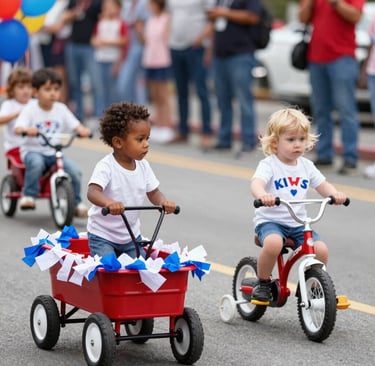
Wednesday - Loud and Soft
When you talk about fireworks with preschoolers, the goal is to explore a thrilling real-world event through contrasts—specifically loud vs. soft sounds and fast vs. slow movements.
Because some young children can find the booming sounds of fireworks a little intimidating, this discussion is also a wonderful tool for social-emotional learning. By practicing the sounds themselves in a safe, playful classroom setting, children gain a sense of control and comfort over something that might otherwise startle them.
Here is a detailed guide and interactive script for running this circle time discussion.
Circle Time Prep & Props
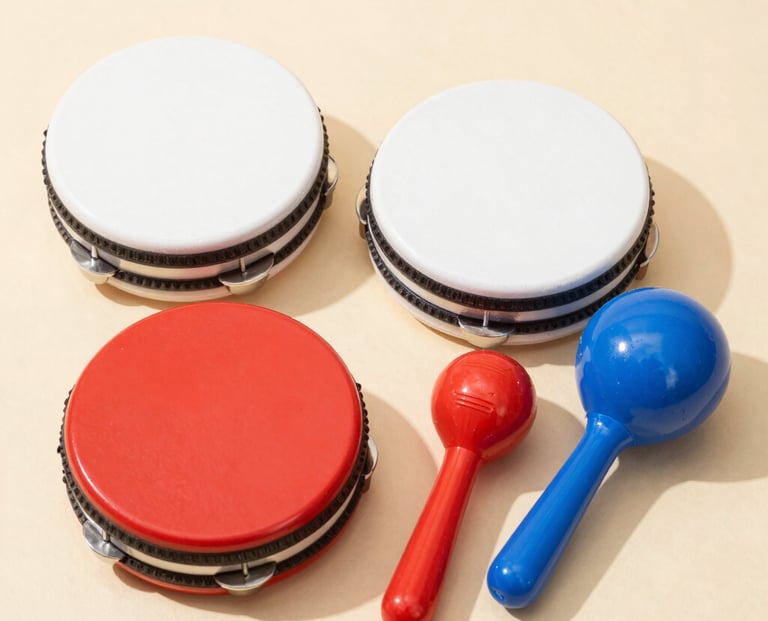
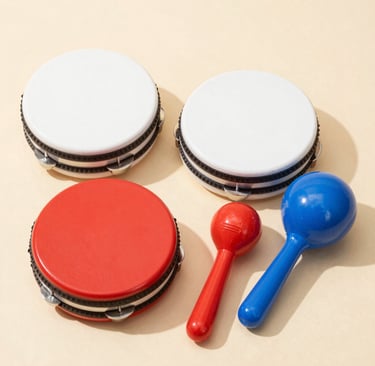
A "Loud" instrument: A drum, a pair of rhythm sticks, or a metal pan with a wooden spoon.
A "Soft" instrument: A shaker egg, a maraca, or a piece of crumpled tissue paper.
Visual Aid: Strips of red, white, or blue yarn to represent firework streaks. (We used variegated yarn and cut pieces of the different colors from one skein of yarn.)
Part 1: The Sound Contrast (Loud vs. Soft)
Teacher: "Class, on the Fourth of July, when the sky gets dark, something amazing happens. Big flashes of light go up in the air, and we hear a lot of different noises. Let’s use our ears and our voices to practice those sounds today.
Some fireworks are incredibly LOUD! They sound like a big giant drum. (Give your drum or pan one loud, sharp tap) BOOM! Can you make a big, loud boom voice with me? One, two, three... BOOM! Wow, that shook our bellies!"
Children: "BOOM!"
Teacher: "But guess what? Not all fireworks are loud. Some are so quiet and SOFT that you have to listen very closely. They sound like tiny little sparkles. (Gently shake your egg shaker or rub tissue paper together) They go crackle, crackle, sizzle, whisper... Can you use your quietest whisper voice and make that sound with me? Sizzle, crackle, whisper..."
Children: (Whispering) "Sizzle, sizzle, crackle..."
Part 2: Active Listening Game ("The Noise Conductor")
Teacher: "We are going to play a game with our ears. I am going to hold up an instrument.
If you see my Loud Drum, I want you to clap your hands one time and yell 'BOOM!'
If you see my Quiet Shaker, I want you to wiggle your fingers in the air and go 'Sizzle, sizzle.' You have to watch my hands closely so you know which sound to make!"
(Spend 2–3 minutes alternating between the two instruments. Speed up the changes to challenge their executive functioning and listening skills. Kids love trying to keep up with the fast switches!)
Wednesday - Loud and Soft
When you talk about fireworks with preschoolers, the goal is to explore a thrilling real-world event through contrasts—specifically loud vs. soft sounds and fast vs. slow movements.
Because some young children can find the booming sounds of fireworks a little intimidating, this discussion is also a wonderful tool for social-emotional learning. By practicing the sounds themselves in a safe, playful classroom setting, children gain a sense of control and comfort over something that might otherwise startle them.
Here is a detailed guide and interactive script for running this circle time discussion.
Circle Time Prep & Props
A "Loud" instrument: A drum, a pair of rhythm sticks, or a metal pan with a wooden spoon.
A "Soft" instrument: A shaker egg, a maraca, or a piece of crumpled tissue paper.
Visual Aid: Strips of red, white, or blue yarn to represent firework streaks. (We used variegated yarn and cut pieces of the different colors from one skein of yarn.)
Part 1: The Sound Contrast (Loud vs. Soft)
Teacher: "Class, on the Fourth of July, when the sky gets dark, something amazing happens. Big flashes of light go up in the air, and we hear a lot of different noises. Let’s use our ears and our voices to practice those sounds today.
Some fireworks are incredibly LOUD! They sound like a big giant drum. (Give your drum or pan one loud, sharp tap) BOOM! Can you make a big, loud boom voice with me? One, two, three... BOOM! Wow, that shook our bellies!"
Children: "BOOM!"
Teacher: "But guess what? Not all fireworks are loud. Some are so quiet and SOFT that you have to listen very closely. They sound like tiny little sparkles. (Gently shake your egg shaker or rub tissue paper together) They go crackle, crackle, sizzle, whisper... Can you use your quietest whisper voice and make that sound with me? Sizzle, crackle, whisper..."
Children: (Whispering) "Sizzle, sizzle, crackle..."
Part 2: Active Listening Game ("The Noise Conductor")
Teacher: "We are going to play a game with our ears. I am going to hold up an instrument.
If you see my Loud Drum, I want you to clap your hands one time and yell 'BOOM!'
If you see my Quiet Shaker, I want you to wiggle your fingers in the air and go 'Sizzle, sizzle.' You have to watch my hands closely so you know which sound to make!"
(Spend 2–3 minutes alternating between the two instruments. Speed up the changes to challenge their executive functioning and listening skills. Kids love trying to keep up with the fast switches!)
The Grand Finale Ribbon Dance
Friday's ribbon dance serves as the perfect active wrap-up to the entire week. Now that the children have spent the morning measuring, comparing, and sorting the various lengths of red, white, and blue ribbons during math time, they get to select their favorite pieces for creative movement.
You can take the class outdoors to the sidewalk or grass and put on the majestic orchestral marches discussed earlier (like The Stars and Stripes Forever or You're a Grand Old Flag).
Because it is Friday, you can combine all the imagery they learned throughout the week into one big movement game:
"Be a Firework!" Have them reach up on their tiptoes, flicking their wrists to make their ribbons crackle and sizzle high in the air.
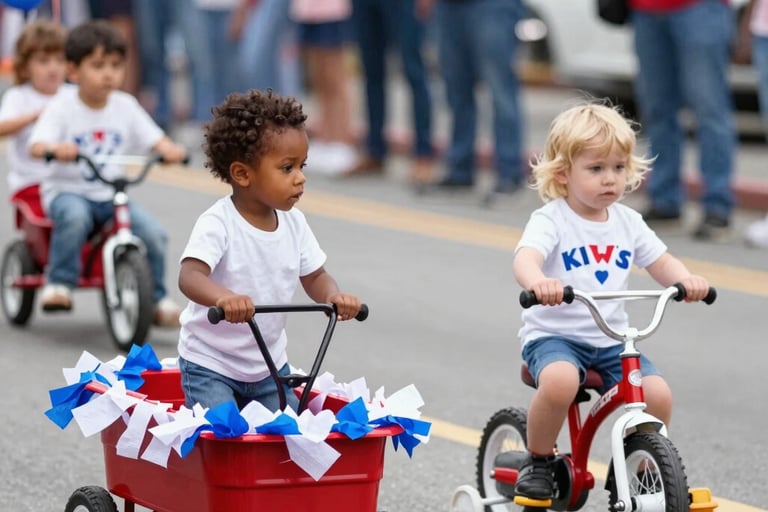
"March in the Parade!" Have them high-step along a chalk line, sweeping their ribbons from side to side to make giant waves.
"Draw a 250!" Challenge older preschoolers to move their whole arms to trace massive shapes and invisible giant birthday numbers in the sky.
It's a joyful, sensory-rich way to let them celebrate the theme, build gross motor coordination, and end the school week on a high note!
Friday: Review
Measuring patriotic ribbons is a fantastic way to bring early math concepts like length, comparison, and estimation into your 4th of July unit. For preschoolers, math should always be tactile and concrete—moving away from worksheets and focusing on hands-on exploration.
Here is a guide on how to set up an engaging, play-based ribbon-measuring station, along with specific learning prompts to use with your students.
📐 The Setup: The Ribbon Exploration Station
Gather a variety of red, white, and blue ribbons. To make the learning rich, choose ribbons with different textures and widths (e.g., shiny satin, rough grosgrain, glittering mesh, and velvety textures).
Cut the ribbons into varying lengths:
Short pieces: 3 to 6 inches (great for little hands to hold completely).
Medium pieces: 1 to 2 feet (about the length of a child's arm).
Long pieces: 4 to 6 feet (longer than the children are tall!)
🎲 3 Hands-On Measuring Activities
Preschoolers learn best by comparing objects directly against each other or using "non-standard" measuring tools before they ever touch a real ruler.
"Is It Taller Than Me?" (Direct Comparison)
The Play: Have a child hold one end of a long blue ribbon at their toes, and let it stretch up their body.
The Math Prompt: "Look at this giant ribbon! Is it shorter than your knees, or does it reach all the way past your belly button? Let's see if this red ribbon is longer or shorter than you are!"
The Benefit: Helps children understand the language of measurement (longer, shorter, taller, equal).
Measuring with Unifix Blocks (Non-Standard Units)
The Play: Tape a few distinct lengths of ribbon flat to a table. Provide a basket of plastic math cubes or Unifix blocks. Have children snap blocks together to match the exact length of each ribbon.
The Math Prompt: "This shiny red ribbon is exactly 5 blocks long. Let's count them: 1, 2, 3, 4, 5! Do you think this sparkly white ribbon will need more blocks or fewer blocks?"
The Ribbon Sorting Parade (Seriation)
The Play: Give a small group of children 3 to 5 ribbons of obviously different lengths. Ask them to work together to lay them out on the floor from the shortest ribbon all the way to the longest ribbon.
The Math Prompt: "Let's make a ribbon staircase. Find the tiniest baby ribbon first. Now, which one comes next? Excellent, you lined them up from smallest to biggest!"
🗣️ Vocabulary & Math Talk to Reinforce
While the children are playing, you can naturalistically drop these comparative words into conversation to build their mathematical language:
Length - "Let's stretch it out completely flat so we can see the whole thing."
Comparison -"When we put the ends together side-by-side, which one sticks out further?
Estimation - Before we count the blocks, make a guess with your eyes! How many blocks long do you think it is?
Width - Feel how wide and thick this blue ribbon is, and look how skinny and thin the white ribbon is!"
💡 Teacher Tip: This activity makes an excellent prelude to the ribbon dancing activity! Once the children have spent the morning measuring, comparing, and sorting the ribbons, they can choose their favorite long piece to tape to a popsicle stick or cardboard ring for music and movement time.
The Grand Finale Ribbon Dance
Friday's ribbon dance serves as the perfect active wrap-up to the entire week. Now that the children have spent the morning measuring, comparing, and sorting the various lengths of red, white, and blue ribbons during math time, they get to select their favorite pieces for creative movement.
You can take the class outdoors to the sidewalk or grass and put on the majestic orchestral marches discussed earlier (like The Stars and Stripes Forever or You're a Grand Old Flag with The Kiboomers or Cedarmont Kids).
Because it is Friday, you can combine all the imagery they learned throughout the week into one big movement game:
"Be a Firework!" Have them reach up on their tiptoes, flicking their wrists to make their ribbons crackle and sizzle high in the air.
"March in the Parade!" Have them high-step along a chalk line, sweeping their ribbons from side to side to make giant waves.
"Draw a 250!" Challenge older preschoolers to move their whole arms to trace massive shapes and invisible giant birthday numbers in the sky.
It's a joyful, sensory-rich way to let them celebrate the theme, build gross motor coordination, and end the school week on a high note!
HAPPY 4TH OF JULY!
Get in touch
Questions? Comments? Concerns?
info@joyfulletters.com
Affiliate Disclosure: Some of the links on this page are affiliate links. As an Amazon Associate, a Walmart Partner, and an affiliate for select educational brands, I earn a small commission from qualifying purchases. This never raises the price for you. I only recommend items that add true value to a play-based learning environment. Thank you so much for supporting our page!
© Joyful Letters 2025-2026 ALL RIGHTS RESERVED. Permission is given to reproduce for individual classroom use. Our content material is not to be resold.
Follow us on Facebook